The enactment of Law No. 15.269, on November 24, 2025, modernizes Brazil's power sector regulatory framework with a focus on energy security and fair tariffs.[1] The rule structures the opening of the free market to low-voltage consumers, setting a 24-month timeline for commercial and industrial consumers and 36 months for the rest. To guarantee continuity of service, it creates the Supplier of Last Resort (SUI), regulated by ANEEL, which will serve free-market consumers in cases of contract termination or a retailer's bankruptcy. On the financial side, the law adjusts how the Energy Development Account (CDE) is apportioned starting in 2026, balancing costs across voltage levels. The legislation also establishes financial compensation for generation cuts (curtailment) at wind and solar plants caused by grid reliability constraints, conditioning payment on generators signing a commitment waiving legal action on the matter.
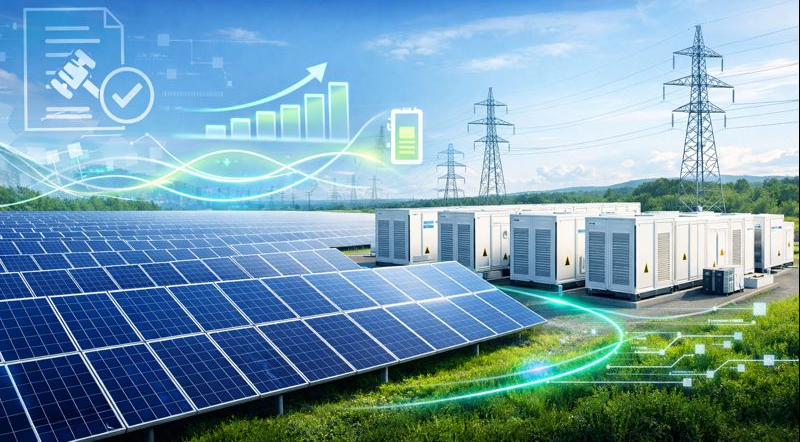
Energy storage gains specific regulation under ANEEL's oversight, which will define access and remuneration rules. Reversible hydroelectric plants remain under the centralized planning of the Energy Research Company (EPE), while battery storage systems (BESS), when connected to the main grid, must be contracted through public tender and may operate autonomously or tied to other projects.
To make BESS projects economically viable, the law extends the benefits of the Special Incentive Regime for Infrastructure Development (REIDI) to the segment between 2026 and 2030, with an annual cap of R$1 billion, and authorizes a reduction to zero of the Import Tax on batteries and their components. This combination of incentives has real potential to sharply cut equipment acquisition costs and directly impacts the Distributed Generation segment. The legislation establishes that solar generation projects, including distributed micro- and mini-generation (MMGD), can only access REIDI's tax benefits if they include chemical energy storage systems in their design — decisively pushing the shift toward hybrid systems.
Given this new landscape, the complexity of determining a hybrid system's optimal configuration rises substantially, demanding a higher degree of mathematical rigor. In this context, advanced sizing tools become essential — tools capable of processing the many technical, regulatory, and economic variables involved, to ensure optimized, safe, and financially efficient projects for this new phase of the power sector.
To meet that need, Grid Design runs the project's technical-economic optimization back at the conception stage, defining the highest-return architecture and mitigating investment risk. The tool sizes hybrid systems with the agility and technical rigor a real operation needs, covering both grid-connected (on-grid) and standalone (off-grid) scenarios.
That said, the viability calculated during sizing only holds up if real-world operation follows the same logic as the design. That's why the solution extends into the plant's day-to-day: Grid Control takes on the role of operational "brain," running automatic, optimal energy dispatch to make sure the planned efficiency is actually delivered, and Grid Monitor closes the reliability loop. It turns operation into visible data through remote monitoring, ensuring energy security and performance visibility across the asset's entire useful life.
The modernization brought by the new legislation makes clear that the future of the power sector is hybrid, intelligent, and digital. With tax incentives for storage now on the table, whoever masters the sizing and management tools will get ahead. Don't let complexity get in the way of capturing these benefits. The technology to design, operate, and monitor the future of energy already exists, and it's within reach.
We invite you to take a closer look at how STEMIS's Grid line can power your next projects.
References
[1] BRASIL. Lei nº 15.269, de 24 de novembro de 2025. Moderniza o marco regulatório do setor elétrico para promover a modicidade tarifária e a segurança energética, estabelece as diretrizes para a regulamentação da atividade de armazenamento de energia elétrica, prevê medidas para facilitar a comercialização do gás natural da União, cria incentivo para sistemas de armazenamento de energia em baterias e altera diversas Leis. Diário Oficial da União: seção 1, Brasília, DF, p. 2, 25 nov. 2025. Available at: https://www.planalto.gov.br/ccivil_03/_ato2023-2026/2025/lei/L15269.htm. Accessed: Dec 10, 2025.